

友情鏈接
- Copyright ? Science and Technology Daily, All Rights Reserved
- 科技日報社 中國科技網 版權所有
- 京ICP備06005116號
- 違法和不良信息舉報電話:010-58884152
- 京公網安備 110402500060


A Warring States Period Qin tripod-shaped bronze lamp was unearthed in 1974 in Pingliang, Gansu province, an important part of the Silk Road. The lamp is now on display in the Gansu Provincial Museum because of its unique scientific and historical value.
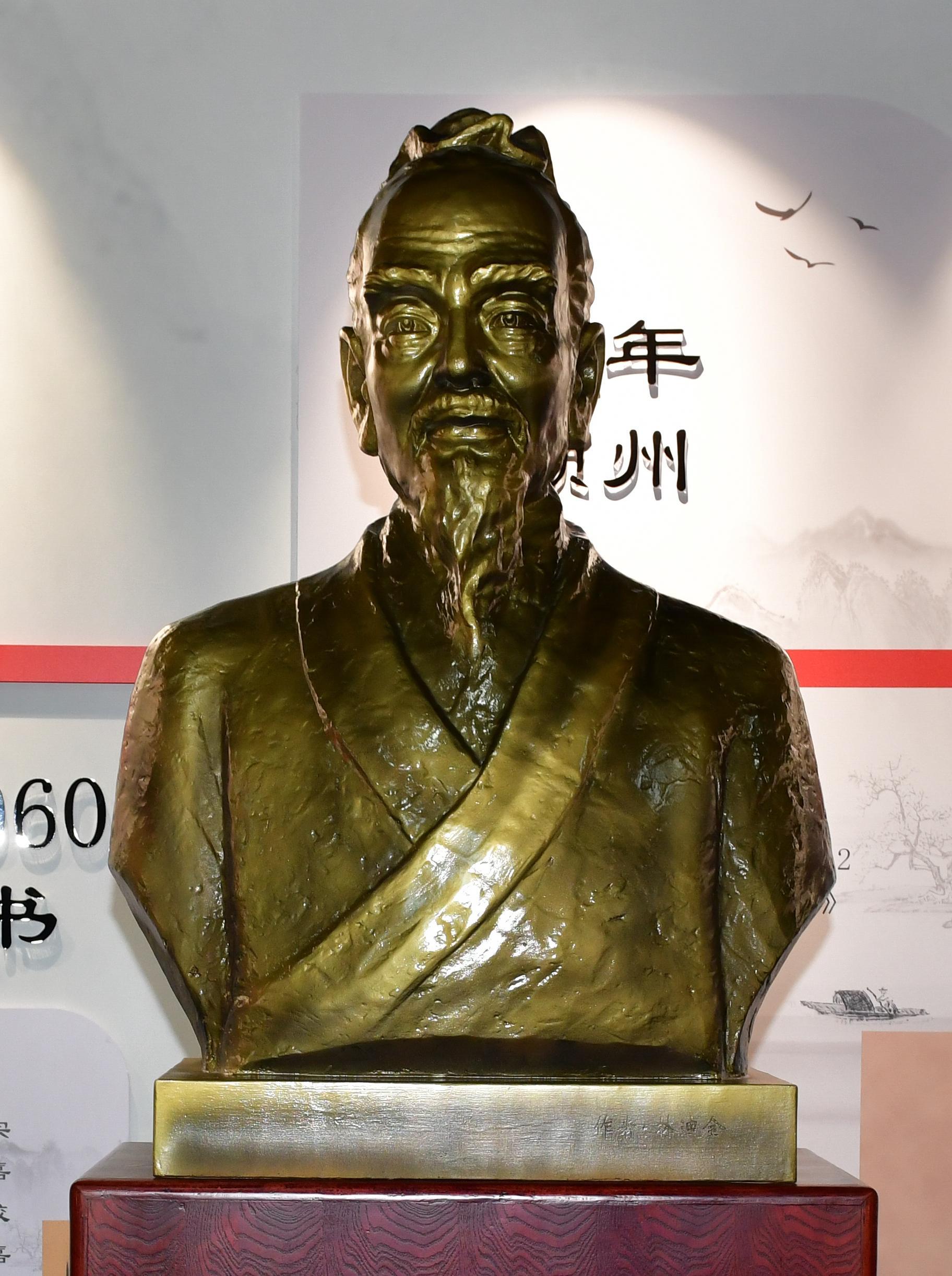
About 1,000 years ago, a hydro-mechanical astronomical clock tower was built in central China during the Northern Song Dynasty (960-1127), creating a number of world-firsts. The biggest contributor to the nearly 12-meter high tower was Su Song, polymathic scientist and statesman.

Brick carving, an art form in Chinese architectural sculpture, refers to the intricate craftsmanship of carving landscapes, flowers, figures, and other rich patterns on blue bricks.

In Chinese Buddhist statue art, suspended sculpture is a relatively uncommon form of art. Suspended sculptures are typically supported by walls or beams, with colorful sculptures hanging on fixed wooden frames.

?On November 17, iconic Southern Tang (937–975) Dynasty painter Gu Hongzhong and his masterpiece the Night Revels of Han Xizai, a massive scroll-painting over 300 cm long detailing in five progressive sections a banquet thrown by a minister with music and dancing,came alive in Beijing through the wonders of modern technology.
The hand warmer, a small, often square or round mini portable furnace filled with burning charcoal, with a hollow lid on top, is one of the innovative winter heating devices used in ancient China. Usually made of copper or enamel, the hand warmer could fit in the hand or be placed in the sleeve for heating, similar to the heating pads used today.

Chinese people have long known how to use oxen and horses to pull carts, with cattle being the main draft animal. However, it was after Spring and Autumn Period (770 BC-476 BC), that animal husbandry was rapidly popularized throughout the country, and the frame structure of the plow was basically established in the Han Dynasty (202 BC-220) and continuously improved with the needs of production.

The use of bow and arrow for hunting and warfare dates back to the Paleolithic period in many parts of the world. Thousands of years ago, the crossbow was then invented by Chinese on the basic bow design, expanding the use of mechanical and hand-held weapons, and revolutionizing the battlefield.

As one of the most important grain crops, rice supports more than 50 percent of the global population. Being the birthplace of rice cultivation, China has always contributed its agricultural wisdom to further increase rice production and improve people's livelihood.

?Pottery dating back almost 10,000 years are part of the latest discoveries unearthed at the Xiatang historic site. News of the ancient artifacts was revealed at an archaeological conference held from October 25-27 in Xianju county, east China's Zhejiang province.

The Temple of Heaven is one of the most significant heritage sites along Beijing's Central Axis. As the main structure of the Temple of Heaven, the Hall of Prayer for Good Harvests stands on a three-tiered pedestal made of pure white marble, making it one of the tallest ancient buildings in Beijing.


A Chinese video game, Black Myth: Wukong, has become a global sensation. Its latest trailer has an arresting dialogue: "Use powerful methods, but have a compassionate heart and that's your destiny." This reflects the essence of the game's central character, Sun Wukong, or Wukong, a figure with a strong will, a rebellious streak and persistence.

Yongle porcelain, also called sweet white porcelain, was produced during the Ming Dynasty's Yongle period (1403-1424), and features a special glaze giving a smooth and creamy appearance. This kind of porcelain was described in ancient times as "white like congealed fat, immaculate like piled-up snow," denoting the highest level of ancient Chinese white porcelain.

The abacus, a manually operated counting aid that originated in China, was hailed as "the fifth great invention in China" by Joseph Needham, a renowned British biochemist and historian. Before the advent of Arabic numerals, the abacus was a widely used counting tool globally.

A bronze sun-shaped device, unearthed at the Sanxingdui Ruins in Sichuan province, has a history of more than 3,000 years. The circular device, around 84 cm in diameter, has a protruding center like the sun. Five arms are radially connected to the surrounding halo. The circular hole in the center of the device and five equally spaced circular holes on the halo are all used for fixing purposes.

Among the gold masks unearthed at the Sanxingdui archaeological site, one that covers only half a face holds China's record for the heaviest gold object.

The grand statue of a human figure in bronze, on display at the new Sanxingdui Museum in Sichuan province, southwest China, is the tallest and most complete standing bronze figure in existence.

In ancient times, the military deployed a vehicle equipped with a cabin for observing enemy movements from a high altitude, known as the Nest Car because the cabin was suspended high up on a pole, just like a bird's nest.

The world's earliest wind direction instrument, the copper bird, was invented by Zhang Heng (78-139), a renowned scientist in the Eastern Han Dynasty. It resembles a bird made of copper with a short head and a long tail, placed on a straight pole about 16 centimeters high. When the wind blows, the direction pointed by the bird's head is that of the wind.

?Chinese President Xi Jinping sent a congratulatory message to the 7th China-Russia Energy Business Forum in Beijing on November 25, sparking enthusiastic responses from various sectors in both countries.
Liang Wenfeng, founder and CEO of the Chinese AI firm DeepSeek, and "deep diver" Chinese geoscientist Du Mengran are on the annual "Nature's 10" list, which highlights 10 people at the heart of some of the biggest science stories of 2025.