

China’s Ecological Civilization Shaping a Sustainable Future

As climate change and environmental degradation challenge development models around the globe, countries are searching for pathways that balance economic growth with ecological protection. In this context, China’s approach to environmental governance is drawing increasing international attention.
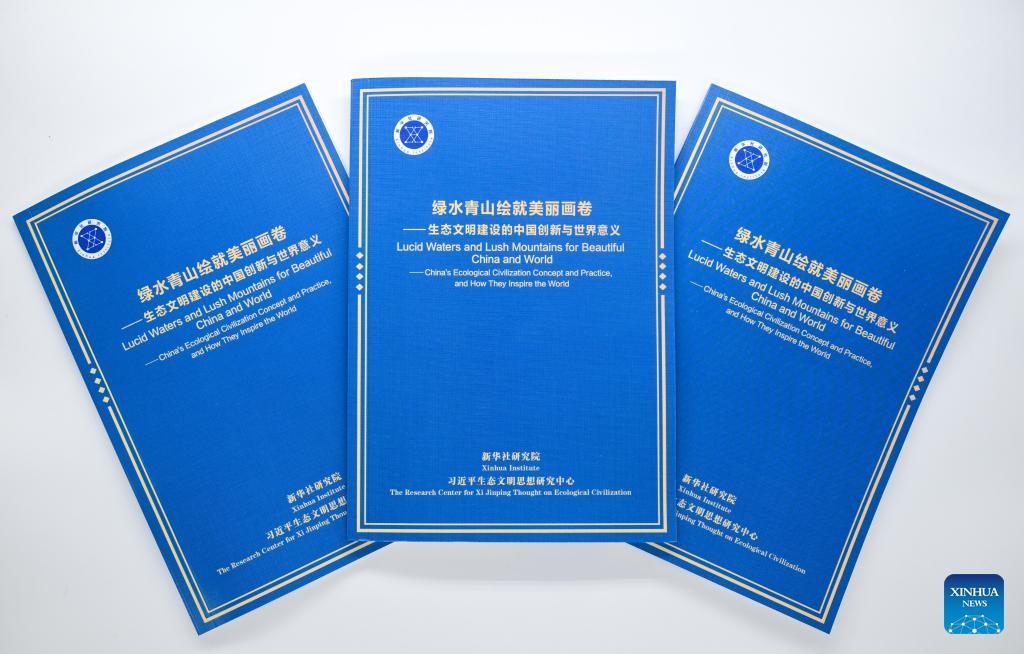
A recent report released by the Xinhua Institute and the Research Center for Xi Jinping Thought on Ecological Civilization explores this shift in depth. Titled “Lucid Waters and Lush Mountains for a Beautiful China and World: China’s Ecological Civilization Concept and Practice, and How They Inspire the World,” the report examines how China’s environmental policies have evolved over the past two decades and the practical insights they offer for sustainable development.
Speaking at a symposium on the report, Ren Weidong, deputy editor-in-chief of Xinhua News Agency, said the evolving concept, enriched and refined through practice, has not only guided China in achieving remarkable ecological and green development progress, but also offers Chinese wisdom and solutions to advance global sustainable development.
One of the most tangible examples of this approach is Yucun, a village in Zhejiang province in east China. It is also the birthplace of the concept of " Lucid waters and lush mountains are invaluable assets ."It is the philosophy of sustainable economic development without environment degradation.
Once dependent on mining and polluted as a result, the village began transitioning to eco-tourism in 2005. Over the following years, degraded hills were reforested, rivers restored, and new green industries emerged. Today, Yucun has been named one of the "Best Tourism Villages" by the United Nations World Tourism Organization, and its growth model of "turning green into gold" has boosted villagers' income.
“The change has been life-changing,” said Wang Yucheng, secretary of the Communist Party of China branch in Yucun. “We’ve proven that protecting the environment can lead to better livelihoods.” The success has inspired neighboring communities to collaborate on shared ecological development, forming a regional alliance that extends the model beyond a single village.
This kind of transformation is no longer seen as only a local experiment. It has begun to attract interest from policymakers and researchers around the world.
Wang Haiqin, deputy director at the Institute of Resources and Environment Policies, Development Research Center of the State Council, spoke about a shift in how international institutions engage with China. “For decades, the World Bank brought international experience to China,” she said. “Now, it shares China’s proven models with the world.”
That shift is also reflected in the establishment of the China-WBG Global Center for Ecological Systems and Transitions, launched by China’s Ministry of Finance and the World Bank in 2024. The center serves as a platform for other countries to learn from China’s experience in desertification control, wetland restoration, and sustainable planning. Delegations from Africa, Latin America, and Europe have visited the center to study how ecological and economic goals can be pursued together.
As more countries face the challenge of building economies without degrading their natural systems, China’s integrated approach offers a different way forward.
This growing role in global environmental governance is also evident in international cooperation. China is advancing ecological collaboration through efforts like the Belt and Road Initiative.
Professor Zhang Haibin, deputy dean of Peking University’s Institute of Carbon Neutrality, explained that these projects support sustainable infrastructure in Asia, Africa, and Latin America, helping partner countries meet climate and development goals simultaneously.
“The ‘Two Mountains’ theory offers a systemic approach,” Zhang said. “It shows that environmental protection and economic growth don’t have to be opposing forces.”
The practical nature of China’s ecological policies makes them particularly relevant to other nations. Professor Lin Zhen, director of Beijing Forestry University’s Ecological Civilization Research Institute, emphasized that many developing countries see in China’s experience a way to pursue both socio-economic development and environmental protection at the same time.
An African student has taken Lin’s course three times to seek new insights into how ecological policies translate into development fruits. “The ‘Two Mountains’ concept is not just theoretical,” Lin said. “It’s a practical, replicable model that can be adapted to different contexts.”
Even in the West, where industrial modernization has long shaped environmental thinking, China’s ecological philosophy is finding resonance. Andrew Schwartz, co-founder and executive vice president of the Institute for Ecological Civilization, said via video, “China offers a path forward that restores harmony between humanity and nature.”
Schwartz summarized the shift simply: “Green is gold.” And in his view, China’s experience shows that poverty alleviation and environmental protection can go hand-in-hand. “China provides something different and better, an alternative model that integrates ecology and development,” he said.
China’s journey toward ecological civilization is still unfolding. By treating ecosystems not as obstacles but as assets, China offers a model that is both pragmatic and forward-looking.