

Young International Scientists Say China's Research Environment Highly Dynamic, Collaborative
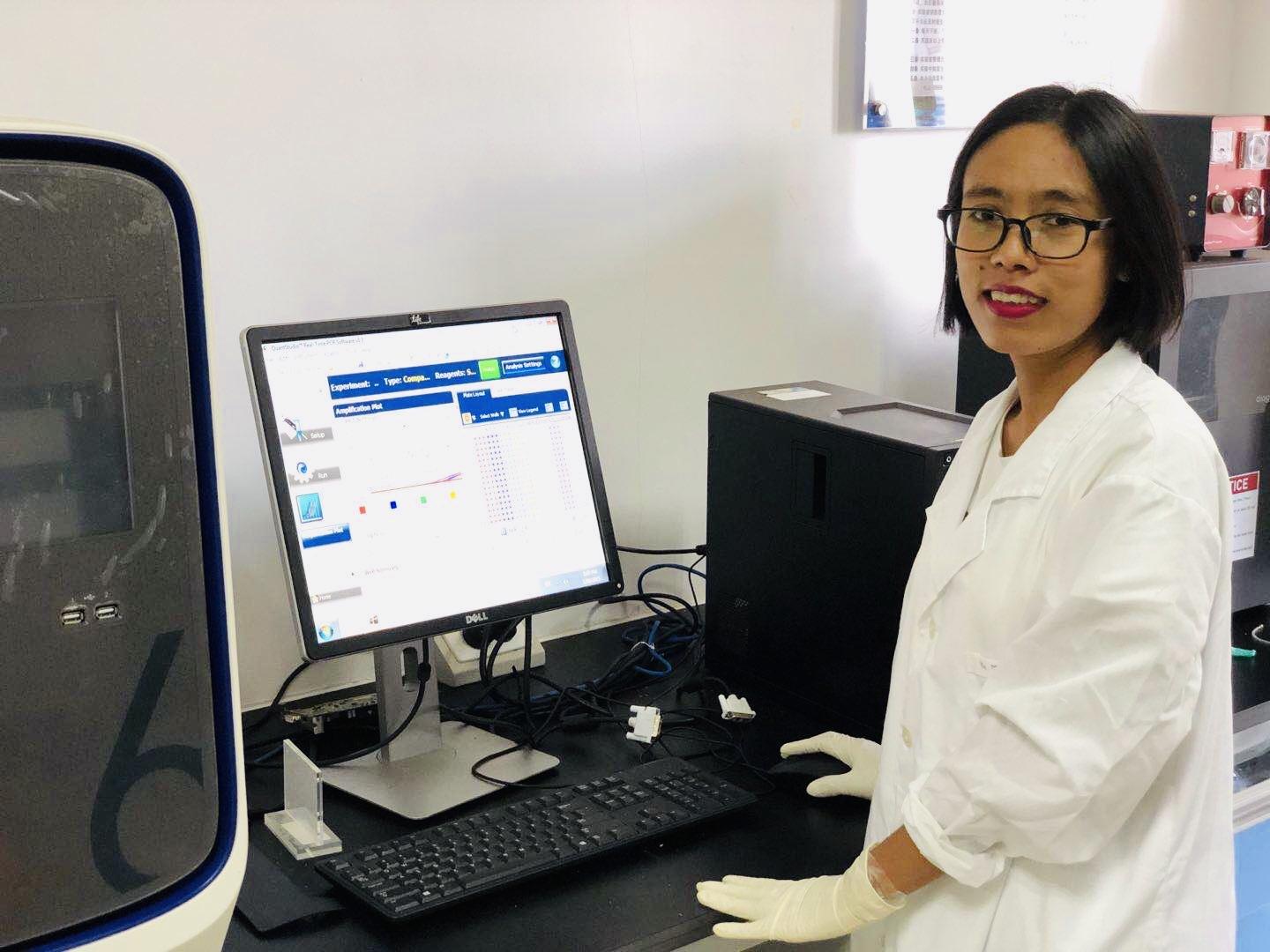
Yin Min Htwe, a former civil servant in Myanmar, is currently pursuing her academic career in China as an assistant researcher at the Coconut Research Institute of the Chinese Academy of Tropical Agricultural Sciences (CRICATAS). Based in Sanya, a coastal city in Hainan in south China, she calls China her second home.
A new chapter
In 2016, Yin was working at the Biotechnology Department of Myanmar when she learned there was an opportunity to conduct research in China as a visiting scholar. Yin, who had a PhD in biotechnology from Mandalay Technological University in Myanmar, decided to apply and was accepted.
"Though she didn't have much research output at that time, her academic background matched what we do here, so we offered her the position," Wang Yong, a professor at CRICATAS and Yin's supervisor, told Science and Technology Daily.
They found her to be a diligent researcher. Research is no easy job, and experiments may last till midnight, but Yin showed strong implementation capacity, according to Wang. Turning a research idea into result timely is very important to the entire research project and Yin always did her assignments fast. Her work included data analysis, writing manuscripts and feedback for correction, contributing to the smooth operation of the project.
Yin called her research period at CRICATAS "enriching and transformative." She said the work enhanced her knowledge and skills, particularly in areas such as gene mining and data analysis, and shaped her outlook on applying research to address real-world challenges, especially in palm crop improvement.
Pushing boundaries
After three years' research as a visiting scholar, Yin decided to do full-time postdoctoral research in China as she wished to continue her previous work, and found the research environment in China aligning with her interests in gene mining and data analysis for palm crops.
"The research environment in China is highly dynamic and collaborative with a strong emphasis on innovation and applied research, which fosters a productive and competitive atmosphere," Yin said. "Researchers in China are encouraged to push the boundaries of their fields."
She secured a position with CRICATAS and both were happy about it. "She did well when she was a visiting scholar, so we were glad to continue our cooperation with her," Wang said.
Yin once again proved her worth. She was named as Class E (full-time) talent by the Sanya Yazhou Bay Science and Technology City in 2021, and her research program, in which she is the lead researcher, received the 2024 Fund for Less Developed Regions within the scope of the National Natural Science Foundation of China.
During her stay in China, she also published nine Science Citation Index (SCI) papers as the first author or joint first author.
But she modestly attributes these achievements to others. "I am fortunate to have strong support from my supervisor and all my team members, whose collaboration is invaluable. The SCI papers are a direct result of our collective efforts," she said.
Finding her 'family' in China
Research aside, Yin enjoys her life in China, finding it "welcoming and supportive."
She arrived in Hainan in March 2017 and received unstinting help from her supervisor and colleagues. "They taught me the relevant techniques and how to operate the machines in the laboratory," Yin said. "They are like my family, supporting me all the time. I didn't feel I was in a foreign country."
She in turn helped her fellow researchers to improve their English, Wang said.
Since 2019, Yin has been learning Chinese and can speak fluent Mandarin now. "I want to learn Chinese to gain a deeper understanding of the Chinese culture and China's rich history. Also, knowing the language enables me to communicate more effectively, both in academic settings and in daily life," she said.
Promising prospects
Yin's story is a facet of the sci-tech cooperation between China and Myanmar.
In November, China's Ministry of Science and Technology (MOST) released guidelines to apply for the first batch of key special projects for the 2025 Intergovernmental International Cooperation on Science and Technology Innovation.
Under this cooperation framework, there will be 10 programs for China-Myanmar intergovernmental joint research project with a total fund of 15 million RMB. The fields of research are agriculture, climate change, artificial intelligence, measurement, agricultural machinery, forests and biodiversity.
In 2018, China and Myanmar established an intergovernmental cooperation mechanism on science, technology and innovation. In November that year, MOST and Myanmar's Ministry of Education held the first meeting of the China-Myanmar Joint Committee on Science and Technology Cooperation. The meeting named the priority areas in bilateral sci-tech cooperation, ranging from agriculture and drinking water safety to new energy, traditional medicine, environmental protection, disaster prevention and mitigation, and measurement and standards.
China and Myanmar also collaborate through the Belt and Road Initiative, China-ASEAN Technology Transfer Center, and Lancang-Mekong Cooperation.
With support from MOST, every year Chinese universities, research institutions and enterprises organize technological training sessions for personnel from other developing countries, including Myanmar.
In 2018, a China-Myanmar Joint Laboratory on Radar and Satellite Communications was inaugurated in Yangon. The China (Guangxi)-Myanmar Agricultural Technology Demonstration Base in Myanmar promotes agro-technology.
The eighth Greater Mekong Subregion (GMS) Summit, which concluded in Kunming, Yunnan province in southwest China, on November 7 this year, endorsed the GMS Innovation Strategy for Development 2030. The strategy aims to establish the GMS as a dynamic hub of innovation, creativity, and sustainable development, driving inclusive economic prosperity, and improving the well-being of its people through a more sustainable and integrated economy.
Yin thinks prospects of cooperation between China and Myanmar in science, technology and talent training and exchange are highly promising. Closer collaboration means immense potential for knowledge exchange, joint research projects, and sharing advanced technologies.
She hopes her experiences in both Myanmar and China will enable her to bridge different scientific perspectives and foster meaningful collaborations.
This column is written in cooperation with the China Science and Technology Exchange Center (CSTEC).