
Understanding China in Law, Language
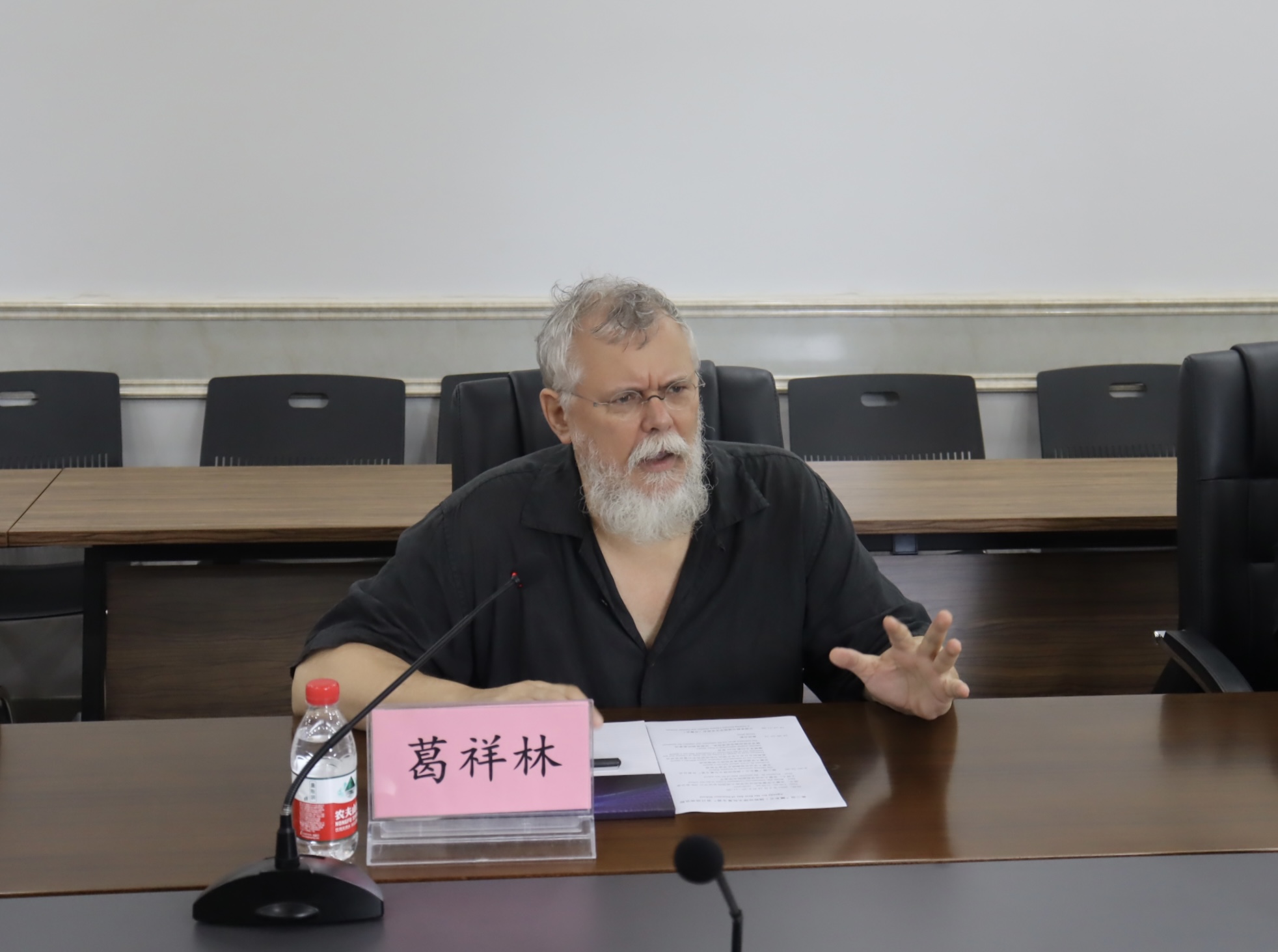
Prof. Georg Gesk.?(COURTESY?PHOTO)
By?BI?Weizi?&?LONG?Yun
Prof. Georg Gesk's 30-year stint in China began in 1986. Today, he is a China expert fluent in Chinese and with a deep understanding of Chinese law and Eastern culture and philosophy.
Recently, he shared his story with Science and Technology Daily as well as his unique insights into China's achievements since the reform and opening up. He said, the Gesks, a German family, had a rich experience of multicultural exchanges and the advantage of speaking foreign languages such as Polish, Hebrew and Russian, but no one had ever been exposed to Chinese except for himself.
Inspired by a special exhibition on Turpan, the unique city in Xinjiang in northwest China surrounded by deserts and mountains, when he was a child, he wanted to study a subject related to "people" and chose Chinese law. However, the language was an obstacle, so he decided to study Chinese first.
"The best way to learn a language is to immerse yourself in local life," Gesk said, "You can't learn Chinese well if you stay in China only for a short time and if you don't learn it the way the Chinese speak it."
"I studied Chinese law in a Chinese-speaking environment. Coupled with the international family environment in which I was raised, I was able to break free from the shackles of Western standardism in academic research," he said.
Eyewitness to China's Development
His first trip to Beijing was in 1990. "I stayed in Beijing for about 10 days, walking around the hutongs (alleys with traditional one-storied houses with courtyards) and talking to local people," he said. The people were very friendly but the environment was different.
He received his Ph.D. in Chinese law in 2000 and then taught in China until 2015. Then he returned to Germany, from where he continued to work as a part-time professor in some famous Chinese universities, including Anhui University and the China University of Political Science and Law. He is one of the few chair professors of Chinese law in Europe, providing systematic training to students majoring in Chinese law.
He returns to China almost every year. In February this year, he attended a science and technology forum where top scientists from around the world talked about the world's scientific and technological development and trends. According to a study by an Australian think tank, China now has a "stunning lead" in 37 out of 44 critical and emerging technologies, a significant progress since the 1970s. Gesk has seen China's leapfrog development firsthand.
"In the 1990s, my teacher told me that it usually takes three generations for a country to become a world leader in a particular S&T field, but it took China only about 40 years," Gesk said, adding that it is difficult for those who have never been to China to imagine what China is like today. That is why he urges everyone, especially students, to come to China and see for themselves. He also stressed the importance of learning Chinese in deepening mutual understanding between China and Europe.
Tackling problems with pluralism
Today, more and more young Europeans are coming to China to travel or study. Gesk believes this phenomenon can be explained by an old saying, "The base determines the superstructure". China today is a very important trading partner for Western countries, but Westerners don't know enough about China. "In order to achieve a truly international exchange of equality and mutual trust in the future, we need to get rid of individualism," he said.
China has been Germany's most important trade partner for eight consecutive years, according to German official trade statistics, but Gesk feels that Germany hasn't understood what China is or the Chinese law, which poses risks for both sides. This made him start teaching Chinese law at the University of Osnabrück in Lower Saxony, Germany, in 2015. He thinks some divergences can be solved or even avoided with the help of legal professionals.
"Only by going to China and learning the Chinese language and culture on the spot can you really understand what the other party is thinking and doing, and achieve true two-way, in-depth exchange and cooperation," he said. As he sees it, pluralism is the way to deal with the differences between different cultures.
Anhui University and Anhui Provincial Department of Science and Technology also contributed to the article.